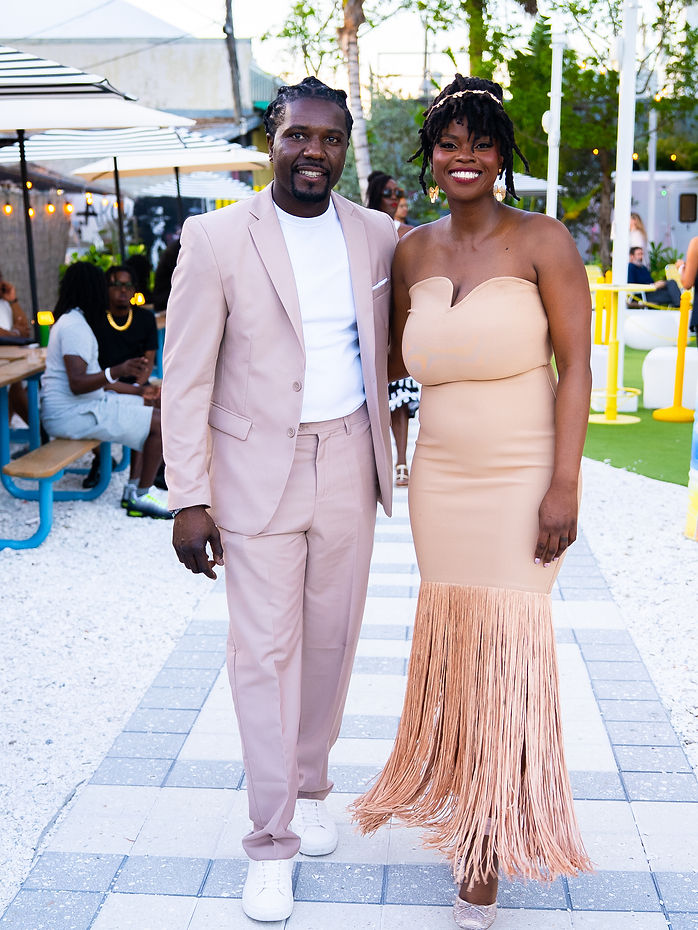
FIERA FEATURE
Meet Marie
The Woman Who Stopped Building Everyone Else's Dream and Started Building Her Own
From a childhood that taught her to rely on herself, to building a career in Human Resources and eventually launching Lakai Liqueurs, Marie’s story is about healing, mentorship, motherhood, and finally choosing to build something of her own
Plantation, FL
August 2026
The Founder

Healing isn’t something that happens to you. It’s something you choose, over and over again
Marie Normil learned very young how to depend on herself. As the fifth of seven children, she grew up carrying lessons about love, trust, and survival that she would not fully understand until adulthood. When her mother left the country during a period of financial hardship, Marie and two of her siblings remained in the United States with family. It was there that she learned one of the hardest lessons of her childhood: blood does not always equal love.
For years, being underestimated became fuel. If someone told Marie she was not qualified, not capable, or not good enough, she worked twice as hard to prove them wrong. That determination eventually led her into Human Resources, where a series of mentors saw potential in her before she fully saw it in herself. Each one helped shape not only the HR leader she became, but the kind of leader she now strives to be for others.
But Marie’s story did not stop with career success.
The pandemic, motherhood, burnout, healing, and a family health crisis forced her to rethink what success actually meant. Somewhere between a Thanksgiving conversation about kremas and her mother’s recipe and the realization that she was tired of selling someone else’s vision, Lakai Liqueurs was born. Today, Marie is building something of her own—and learning that the little girl who once believed she had to face the world alone never needed to prove her worth in the first place.
Tell us your story. What have you overcome, rebuilt, created, survived, or stepped into?
Marie Normil: It’s hard to put my story into just a paragraph or two. I’m the fifth of seven children, and my childhood shaped me in ways I didn’t fully understand until much later in life. It wasn’t the kind of upbringing that taught me the beauty of vulnerability or the safety of trusting others.
At a very young age, my mother faced financial hardships and left the country in search of a better future. My two siblings and I stayed behind in the United States with family. One lesson I learned early is that blood doesn’t always equal love. Some people care for you out of obligation rather than genuine affection, and sometimes they leave wounds that last long after you’ve grown.
If I could speak to my younger self today, I’d tell her, “It’s not you. It’s them.”
Growing up, I didn’t have healthy examples of relationships. I witnessed infidelity, verbal abuse, physical abuse, and broken marriages. The women I was supposed to look up to had become hardened by the pain they had endured. I promised myself I would never become hardened like that. Ironically, without realizing it, I built walls around my own heart so high that very few people could get through them.
One memory has stayed with me all these years. It was my fifth-grade promotion ceremony, and our class sang Whitney Houston’s Greatest Love of All. At the time, I sang those lyrics with all my heart, but I didn’t fully understand why they resonated so deeply with me. Looking back, I realize that little girl was searching for something she desperately needed—love, acceptance, and someone to teach her that she was enough. Instead, she learned to rely only on herself.
My mindset became simple: no heroes, no mentors, no one coming to save me. It was me against the world.
Looking back now, I realize that wasn’t the healthiest perspective for a twelve-year-old to have. But it became my survival strategy.
Because of everything I experienced, being underestimated became my greatest motivation. Tell me I couldn’t do something, that I wasn’t qualified, or that I wasn’t good enough, and I’d work twice as hard to prove you wrong. That determination has fueled every chapter of my life.
I didn’t find Human Resources until I was 30 years old. At the time, I was experiencing what felt like a midlife crisis. I was working as a Spa Supervisor and had no idea what my next career move would be. I think it was about year six since my mom passed away, and trying to find reliable childcare was anything but easy. I found myself overwhelmed, but more than anything, I wanted to make sure my three beautiful children had the childhood I never did—one with present, loving parents, especially a mother and father who were there for them every step of the way.
One day, my Director of Spa and one of our therapists got into an argument. I stepped in to mediate the situation, helping both parties calm down and communicate. Afterward, the therapist thanked me and said something I’ll never forget: “You’d make a great HR leader someday.”
Those words became the sign I didn’t know I was waiting for but desperately needed.
That very night, I updated my resume and applied for every HR Coordinator and HR Administrative position I could find.
Then came Dr. Shelly.
She gave me my first official opportunity in Human Resources, despite the fact that I had almost no experience. I couldn’t confidently explain FMLA, employment law, or many of the technical aspects of HR. But she saw something in me that I couldn’t yet see in myself.
I’ll forever be grateful for her willingness to take a chance on me.
She taught me something that continues to influence how I hire people today. Experience matters, but character matters more. I’d rather invest in someone with drive, determination, integrity, and a strong work ethic than someone with an impressive resume but no passion.
After Dr. Shelly, I had the privilege of working with HR consultant Lisa Perez, who helped build the foundation of my HR career. She introduced me to professional development through Pryor training and encouraged me to truly study Human Resources instead of simply doing the job.
During a workforce reduction, she brought me alongside her for some of the most difficult conversations an HR professional can have. She didn’t shield me from the hard parts—she prepared me for them. Eventually, she trusted me enough to lead some of those conversations myself.
One lesson she taught me has stayed with me throughout my leadership journey: Always prepare the person behind you to take your seat.
That’s how organizations grow, and that’s how leaders leave a legacy. Then came Jose, my next HR Director. He became one of my biggest encouragers. He challenged me to dream bigger, coached me through interviews, and consistently reminded me I was capable of more than I believed. Looking back, I truly believe he helped prepare me for my first HR Manager role.
Then I met Lisa Smith.
At the time, I was painfully shy. Speaking up in meetings terrified me. But Lisa taught me confidence through her example. Watching the way she built and led her team influenced how I lead my own today. Many of the leadership practices I value most were inspired by her.
When I reflect on my career, Dr. Shelly, Lisa Perez, Jose, and Lisa Smith stand out as the people who helped shape the HR professional and leader I’ve become.
I’ve also worked for leaders who weren’t great. Surprisingly, they taught me just as much. They showed me what leadership shouldn’t look like. Every experience became a lesson in what I wanted to carry forward—and what I wanted to leave behind.
Then came the pandemic.
Like so many others, life changed overnight. After helping with countless layoffs, I reached a point where I simply didn’t have the emotional capacity to continue. At the same time, my children were struggling with virtual school, and their grades reflected it.
I made the difficult decision to take a voluntary furlough. It ended up being one of the greatest gifts I’ve ever given myself. Being home with my children during that season is one of my favorite memories. We were fortunate enough to make it work financially, and I don’t take that blessing for granted.
That Thanksgiving, we traveled to Georgia to spend the holiday with my younger sister. We started talking about kremas and our mother’s recipe. Somewhere in that conversation, a thought crossed my mind:
“This could become something.”
Of course, my husband knows that once an idea enters my head, it rarely leaves until I either build it or decide it isn’t the right path. I’ve always known I wanted to own my own business. I just didn’t know what that business would be.
Over the years, I tried different ventures. I became a beauty consultant. I even explored insurance. While many people find success in those industries, they never felt like me. I realized I was selling someone else’s vision instead of creating my own.
When I found Human Resources, I knew that one day I wanted to build my own HR consulting firm—a business where I could lead authentically, help organizations build healthier workplaces, and mentor future leaders.
That dream eventually became Lakai.
Launching Lakai has been one of the most meaningful accomplishments of my career. The vision was clear, and I believed wholeheartedly in what I was building. But as many entrepreneurs learn, having a great idea is only the beginning. Building a business comes with growing pains, unexpected setbacks, and moments that test your resilience.
Life had other plans. I returned to the workforce while continuing to build Lakai because sometimes purpose requires patience, and dreams need stability to survive. Then our family was faced with another challenge when my daughter was diagnosed with an autoimmune disease. Suddenly, my priorities shifted once again. My focus became balancing my career, growing a business, caring for my family, and making sure my daughter had everything she needed.
There were moments when the dream had to slow down—but I never let it die. Through every setback, every detour, and every difficult season, we kept moving forward. Maybe not as quickly as I had imagined, but always with purpose.
Lakai isn’t where I ultimately envision it being, and that’s okay. The journey has taught me that success isn’t measured only by how far you’ve come, but by your willingness to keep going when life demands that you take a different path.
For the first time in my life, I’m not building someone else’s dream. I’m building my own. And along the way, I’ve realized something even more important. The little girl who believed she had to face the world alone was wrong. She didn’t need to prove her worth. She already had it.
What she needed were people who believed in her before she fully believed in herself. The mentors who opened doors, the leaders who took a chance on me, and the people who challenged me to grow changed the trajectory of my life.
Today, that’s the person I strive to be.
I want to create opportunities for others, see potential where others may overlook it, and remind people that their circumstances don’t define their future. If I can be for someone else what so many incredible people were for me, then every challenge I’ve faced has been worth it.
At your lowest point, what did life feel like for you emotionally and mentally? When did you decide to make a change?
Marie Normil: At my lowest point, I felt completely drained. I was living on autopilot, simply going through the motions. Somewhere along the way, I unraveled a little. I didn’t want to show up for anyone anymore.
I was exhausted—physically, mentally, emotionally. I was tired of carrying everything. I remember thinking about Eat, Pray, Love and fantasizing about disappearing for a while. Just leaving. Escaping. Running away somewhere to simply exist without the weight of responsibility.
But then I thought about my children. I thought about the trauma my leaving would leave behind, and for the first time in my life, I found myself extending an incredible amount of grace to my mother. As a child, I couldn’t understand why she left. As a mother carrying the weight of life myself, I finally understood how overwhelming it can become. I didn’t excuse the pain, but I gained compassion for the woman behind the decision.
Giving up, however, was never an option. So I did what so many working Black women have been conditioned to do—I put my “big girl panties” on and weathered the storm. There wasn’t room to fall apart. There were children depending on me, bills to pay, a career to maintain, and a business I was trying to build. Somewhere along the way, I had convinced myself there was no time for a mental breakdown.
I cried until there were no tears left.
Then one day, a realization hit me. The only person I could truly change was myself. If I wanted to raise emotionally healthy children, if I wanted to minimize the trauma they would carry into adulthood, I had to start healing the parts of me that were still hurting. I couldn’t pour into them from an empty cup or expect them to become emotionally whole if I refused to do my own work.
Mina Meetings entered my life.
To this day, it remains one of the best investments I’ve ever made in myself. Better than the vacations. Better than the designer purchases. Better than any material thing I could have bought.
Mina Meetings changed my perspective. It forced me to slow down, look inward, and take ownership of my healing. It reminded me that strength isn’t pretending you’re okay—it’s having the courage to confront the parts of yourself you’ve been avoiding.
Thank you, Mina Sha, for helping me begin that journey.
That season taught me one of the most important lessons of my life: healing isn’t something that happens to you. It’s something you choose, over and over again.
And that’s exactly what I decided to do.
Which fire best describes you?
Marie Normil: The Founder.
What is one life lesson you learned that other women need to hear?
Marie Normil: Find a trusted community and lean on them. Life is filled with highs and lows, and having people you trust to celebrate your victories, encourage you through your struggles, and remind you of your strength when you can’t see it yourself is invaluable.
You don’t have to navigate life’s journey alone.
What quote, mantra, or scripture do you live by?
Marie Normil: One of my favorite scriptures is James 2:17: “Faith by itself, if it is not accompanied by action, is dead.”
You can believe in anything, but if you’re not willing to put in the work, you won’t produce any fruit. Faith requires action. Dreams require discipline. Goals require consistency.
I often ask myself a few simple questions: Did I give it my all? Did I do everything within my control to create the best possible outcome? If the answer is yes, then I can walk away knowing I honored the opportunity. If the answer is no, then I know there’s more work to be done.
I believe we’re all capable of producing fruit, but fruit doesn’t grow from good intentions alone. It grows from showing up consistently, doing the work, learning from setbacks, and trusting God through the process.
Progress is one of the greatest indicators of fruitfulness. It may not always be fast, and it may not always look the way we imagined, but every step forward is evidence that the work is producing something worthwhile.
Also, practice gratitude. One of my favorite books is The Magic, which explores the transformative power of gratitude and how a simple shift in perspective can change your life. It’s easy to focus on what you don’t have or where you haven’t arrived yet. But true contentment begins when you learn to appreciate where you are, while still believing in where you’re going.
Gratitude doesn’t mean you stop dreaming or striving for more. It means you recognize and appreciate the blessings, lessons, and opportunities you already have.
And...
Scared money don’t make money. Don’t be afraid to invest in yourself. The greatest investment you can make is the one you make in your own growth, knowledge, and development. Whether it’s education, mentorship, personal healing, or pursuing a dream, investing in yourself creates opportunities that no one can take away from you.
Growth requires courage. Sometimes you have to take a risk, step outside of your comfort zone, and believe in yourself before anyone else does.
Bet on yourself—you are worth the investment.
What advice would you give to a woman who feels stuck right now?
Marie Normil: You’re not stuck; you’re in the rebuilding and refining season of your life. Sometimes it’s okay to step back and look at the bigger picture. The clarity you’re searching for will come. One thing I’ve learned about myself is that I’m always moving. I don’t think I know how to function without having multiple things on my plate. If I’m not building something, solving a problem, or chasing the next goal, I start to feel restless.
Yet, every now and then, I find myself feeling stuck—whether in my career, my business, or simply in life.
Over time, I’ve realized that what I often mistake for being “stuck” is actually God asking me to pause.
Not because I’m failing, but because He’s preparing me.
Sometimes He’s pouring into us, refining us, redirecting us, or teaching us lessons we couldn’t learn while constantly moving. We become frustrated because we want answers immediately, when what we really need is stillness.
The pause isn’t punishment. It’s preparation. I’ve learned that some of life’s greatest breakthroughs don’t happen while we’re running—they happen when we’re willing to slow down long enough to hear the direction we’re meant to take.
So if this is your season of pause, don’t mistake it for failure. Trust the process. The next chapter will reveal itself when it’s time.
What is one tip you would give to women building a business or career?
Marie Normil: Don’t give up.
Pivot if you need to, pause if you must, but don’t give up. The journey won’t always be easy. Some seasons will be hard, messy, overwhelming, and filled with tears. There will be moments when you’ll question yourself, your purpose, and whether it’s all worth it.
Hang in there.
Growth is rarely beautiful while you’re living through it, but one day you’ll look back and realize every challenge was preparing you for where you’re meant to be.
What are you currently building, working on, or proud of?
Marie Normil: Lakai Liqueurs.
My long-term goal is to officially retire from my HR career and dedicate myself fully to building Lakai.
There was a time when I thought my career path would lead me to a Vice President role. For years, that was the milestone I was chasing. But along the way, I realized something important: I’m not meant to be a politician.
I believe real change doesn’t always start at the top of an organization. Sometimes, the greatest impact comes from creating something of your own—building a brand, a company, and a culture that reflects your values and challenges the status quo.
That’s the legacy I want to leave.
I want to build something that inspires others to think differently, lead authentically, and realize they don’t have to wait for permission to create meaningful change.
Sometimes the best way to change the game is to build a new one, so those coming behind you can see what’s possible and know they can do it too.
Marie’s story is not simply about leaving corporate America behind or building a business. It is about a woman slowly unlearning the belief that she has to do everything alone. For years, being underestimated pushed her to prove herself. Today, she is learning something much more powerful: she never needed anyone else’s approval to establish her worth.
Lakai represents more than entrepreneurship. It represents ownership—of her ideas, her healing, her leadership, and the legacy she wants to leave behind. And perhaps that is Marie’s greatest evolution: the little girl who once believed no one was coming to save her grew into a woman determined to open doors for others.
She is no longer building someone else’s dream.
She is finally building her own.